
18 Ghost Towns in Montana You Have to Make Sure to Visit
This guide contains affiliate links to trusted partners.
Looking to explore the best ghost towns in Montana?
When was the last time you explored a ghost town? Well, if you’re visiting Montana, there are plenty of options to go on a ghost town adventure. You’re never too far away from a Montana ghost town, especially when checking out the other cities in Montana, so take some time to take a walk through history. I highly recommend adding some of these ghost towns in Montana to your Montana road trip if you can!
Ghost towns in Montana are remains of bustling towns established by miners in search of gold. The Gold and Silver booms across the state led to rapid town developments as people arrived for new work. And just as fast as they were created, the towns were quickly abandoned after the mining sites dried up.
[lwptoc hideItems=”1″]
The absolute coolest ghost towns in Montana you have to see
You won’t want to miss these incredible ghost towns in Montana when you are visiting the “Treasure State”–it’s called that for a reason!
1. Coloma
Tucked inside the Garnet Range lies the ghost town of Coloma. Nicknamed the “Mystery Camp,” it’s a peculiar town near the more famous Garnet Ghost Town.
Coloma was established in 1893 but left very little behind to learn more about it. As a result, many of the sites are left in ruins. It is a current archaeological site to uncover some of its mysteries.
Visitors are welcome to walk the site and see the remaining structures. It has evidence of an old mill and mining. You can still see the mining shaft, machinery, and railroad tracks.
 2. Nevada City
 2. Nevada City
Nevada City was once a major city for commerce during Montana’s Gold Rush. While most of the town was destroyed in the past, restoration efforts have transformed it into a living history museum.
Take a walk through town to see how life was like in Montana during the 19th century. The dirt roads are lined with over a hundred different structures, including more than a dozen original buildings. You can walk into the homes to see antique furniture or check out the layover of various stores.
A highlight of Nevada City is the Nevada City Museum and Music Hall. It holds an extensive collection of artifacts from the Old West and vintage music machines. I highly recommend taking a tour of this town and its sister city of Virginia City so you get the most out of your visit!
⭐BOOK NEVADA CITY AND VIRGINIA CITY TOUR HERE⭐
 3. Granite Ghost Town State Park
 3. Granite Ghost Town State Park
While exploring the ghost towns in Montana, be sure to add the Granite Ghost Town State Park to your itinerary. It’s the site of the world’s richest silver mine, which employed approximately 3,000 miners and yielded over $40 million in silver.
Granite Ghost Town was a vast success during its heyday during the 1890s. But once you arrive, only remnants remain of the once boomtown.
You’ll see the remaining building frame of the Miner’s Union Hall, a bank, and the home of the mine superintendent. It has several plaques at each site giving historical information about the town and each site.
4. Bannack State Park
 4. Bannack State Park
On July 28, 1862, a pivotal moment occurred in Montana’s history. Gold was discovered and started the gold rush to the state. The discovery founded the town of Bannack, which boomed to a population of over 3,000 people in less than a year.
Bannack was abandoned entirely in 1950 and became a ghost town. Its legacy is preserved by the Bannack State Park, which welcomes visitors to experience the town that started it all.
Walk the empty streets to see more than 60 original buildings – the governor’s mansion, hotel, log cabin homes, and more. It has a visitor center that offers guided tours of the town.
5. Laurin
Laurin was part of the successful Alder Gulch mining site, where miners created massive wealth during the Montana mining boom. It was established in 1863 by Jean Baptiste Laurin. He took a different approach to growing his wealth by opening a store that sold mining equipment and traded furs with Native Americans.
Today, not much remains of Laurin. All that’s left behind in the ghost town are a few structures still standing that let you imagine how it once looked during its thriving years. One of the famous sites is the Hangman’s Tree, where two infamous gang members were executed.
[vc_row][vc_column]
[vc_cta h2=”Join the community!”]Love the outdoors? Join my free Facebook community where we chat and share information about national parks, hiking, outdoor activities, and more!
JOIN HERE! ⛰️ [/vc_cta]
[vc_column_text]
6. Aldridge
The town of Aldridge was established around the Aldridge mining site during the late 1800s. It had a brief period of success, but operations soon shut down due to a lack of funds. As a result, Aldridge was quickly abandoned and turned into a ghost town.
Aldridge was a bustling coal and iron ore site with hundreds of workers mining it. The town was home to over 800 people and was a thriving economy.
The rapid abandonment of Aldridge left a lot of the town as it was. You can still see many structures, and rumors are that there is still a lot of coal to be mined in the area.
7. Diamond City
It’s hard to believe that the site of Diamond City was once the largest town in all of Montana. It’s part of a region called the Confederate Gulch. The area was home to over a third of Montana’s population during its gold rush as one of the most valuable gold mines in the state.
Diamond City is the perfect example of a boom-and-bust town that occurred in just six years between 1864-1870. After the gold mines dried up, the town was abandoned. It’s not much of a ghost town like other sites due to being completely destroyed. All that remains are a few lumber posts and a graveyard site.
8. Rocky Point
 8. Rocky Point
Not all boomtowns in Montana were caused by mining sites. Other towns played different roles, such as Rocky Point. It was a town established on the mouth of the Missouri River where freight ships arrived to deliver mining equipment.
Rocky Point was a prosperous town thanks to supplying nearby mining camps. It had several stores, saloons, hotels, a post office, and more. Even after the mining boom, it remained populated but became a ghost town after the ferry was shut down.
You can check out the remains of Rocky Point when you visit the Charles M. Russell National Wildlife Refuge.
 9. Garnet Ghost Town
 9. Garnet Ghost Town
Visiting Garnet Ghost Town will surely be one of your favorite Montana ghost towns to visit. It’s the best-preserved town that was once a major hub during the 19th century.
Garnet Ghost Town is a popular tourist attraction near Missoula, Montana. Gold miners once populated it, but all that remains after the buildings.
The unique thing about this site is that all of the buildings are original. Walk inside the general store to see artifacts like old mining equipment and a table of boots. Check out the three-story hotel to see rooms furnished with beds. Or see the simple homes where the miners lived.
Garnet Ghost Town charges a small entrance fee for visitors.
 10. Marysville
 10. Marysville
All it takes is one person to find gold in a location, and the rest is history. That’s the story of the Marysville ghost town. It was founded by “Irish Tommy,” who discovered the Drumlummon Mine, one of the most lucrative gold mines in Montana history.
Marysville was established soon after finding gold to support the influx of people moving to the region. It’s located near the capital of Helena inside the Helena-Lewis and Clark National Forest.
The town once held a few thousand people, but now all of the people and more buildings are gone. However, you can still find a few remaining structures like the church, lodge, and baseball field.
 11. Elkhorn State Park
 11. Elkhorn State Park
Visiting Elkhorn State Park not only means you’ll get to see one of the notable ghost towns in Montana but also experience the smallest state park. Elkhorn was established in 1872 as one of the earliest silver mining towns in the state.
You can walk inside a few of the buildings in Elkhorn State Park. It’s always a surreal experience seeing how things were left as people suddenly left the towns. Two of the best-preserved structures are the Fraternity Hall and Gillian Hall.
Arriving at Elkhorn State Park is one of the eerie ghost towns of Montana as you navigate the only accessible route through backcountry dirt roads.
 12. Virginia City
 12. Virginia City
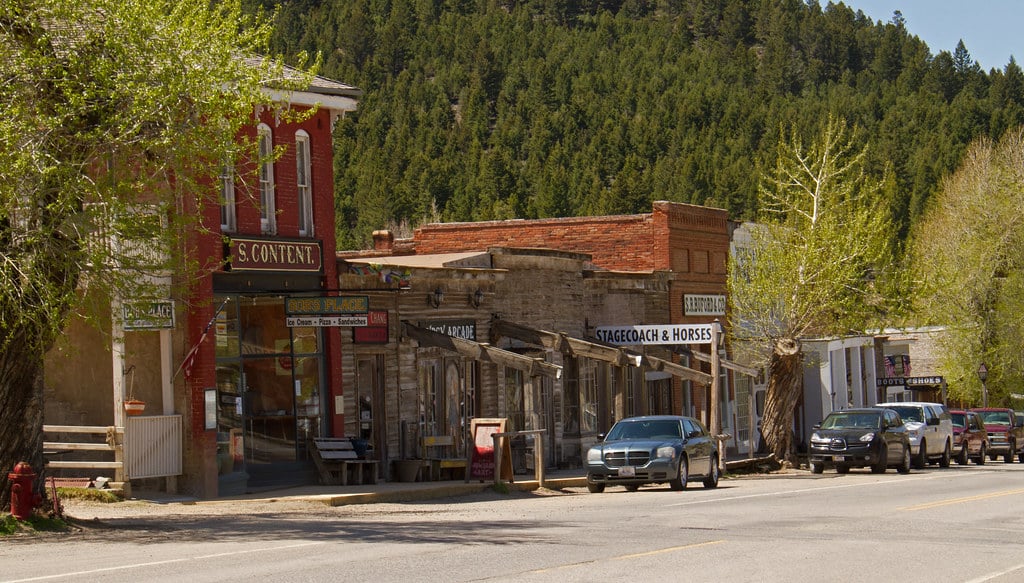
While you’re on your Montana ghost town tour, you can check out two neighboring towns at the same time. Virginia City is the sister city to Nevada City, located adjacent to each other. Many people stop by the sites on their Yellowstone National Park itinerary.
Virginia City is a place left unchanged ever since it was abandoned. The remaining buildings and everything inside are as you would have expected it while it was inhabited. It has a similar fate to other abandoned towns in Montana when the residents got news of gold being discovered near the present-day capital and hastily left everything behind.
⭐BOOK VIRGINIA CITY AND NEVADA CITY TOUR HERE⭐
13. Zortman
Zortman is a once-booming mine town in the Little Rocky Mountains. The remote location kept much of the wealth local where settlers used it to develop the town. It was a thriving place with several general stores, bars, a hospital, hotels, and a jail.
The few remaining buildings, including the old jailhouse, are just a tiny glimpse into the historic town that was once home to 2,000 people. Today, it’s not entirely abandoned – it’s still home to a handful of people – although the empty streets will make you think otherwise.
The locals attempted to bring back mining in the late 1900s, but it soon ceased again.
14. Karst’s Camp
Not all of the Montana ghost towns were about work. Karst’s Camp is a unique ghost town that was more directed towards recreation and hospitality. Its origin is the next best thing to finding gold in Montana.
Pete Karst founded Karst’s Camp in 1902 after being awarded the land near Yellowstone National Park. He eventually built 25 cabins on the grounds to accommodate visitors traveling to the park. During peak season, he could see upwards of 600 people stay in the camp.
After 50 years of operation, Karst’s Camp became another one of Montana’s abandoned towns, leaving behind many cabins and other structures. There are hiking trails through the camp to nearby mining sites.
 15. Rimini
 15. Rimini
If you heard early pioneers talking about Bear Gulch, Tenmile, and Lewis and Clark, they are actually talking about the same city. Rimini is one of the earliest ghost towns in Montana that’s in a state of revival to bring back a sense of local community.
Trek down the gravel road to reach the old town. It’s nestled in a valley since most of the mining activity happened in the nearby mountains. The diverse mines yielded gold, silver, and lead.
Rimini is a very residential-style town. In fact, several of the abandoned miner cabins are being restored and bought for modern living.
16. Rancher
With the town of Rancher located in Treasure County, it’s not hard to guess why it attracted so many people during the mining boom. It’s an excellent example of a historic frontier town frozen in time.
Visiting Rancher lets you see life in the Old West. It’s a popular tourist destination when traveling the area since it’s the only ghost town left in the county. You’ll get to see the abandoned ruins and the landscape that many people called home for a short period.
The ghost town has a lot of mystery behind it, so visit and see what you can uncover.
17. Theony
Theony is one of the abandoned places in Montana that seems to appear out of nowhere when exploring Montana’s northern region. It’s located near the US-Canada border, where the landscape is predominantly flat land.
It was never easy to access Theony since it was quite a distance from the nearest train routes. Nevertheless, it still managed to flourish for some time during the early 1900s. During its peak, it had general stores, a blacksmith shop, and a school.
Today, all you’ll see remaining of the town is the single-room schoolhouse that pays tribute to the town that once was. There is also a cemetery on the site.
18. Wheat Basin
It’s amazing to think about how transportation infrastructure has such an impact on an area. Such is the story of Wheat Basin, a ghost town that suffered due to rerouting the local railways.
Wheat Basin started as a camp while constructing the railroad. After it was completed, the town grew rapidly to approximately 1,000 people. On the main street alone, you would find a bank, dance hall, shops, post office, and more.
With no railroad to support traffic through the town, the residents abandoned everything. There’s a sign left behind paying tribute to the former town. All that’s left are building foundations and the marks of the main road.
Tips for visiting ghost towns in Montana
Here are some of my recommended tips for visiting ghost towns in Montana and how to make the most of your time there.
- Research before you go: Not all ghost towns are open to the public or safe to visit. Some are located on private property or in remote areas with challenging terrain. Make sure to do your research ahead of time to find out what ghost towns are accessible, safe, and legal to visit. Also, knowing the history of the place beforehand will make your visit more meaningful and interesting.
- Pack accordingly: As most of these towns are in remote locations, ensure you have all the essentials with you. Bring plenty of water, snacks, a first-aid kit, and appropriate clothing for the weather. A sturdy pair of hiking boots is always a good idea as well. You should also consider bringing a paper map and a compass as mobile service may be unreliable in these areas.
- Respect the sites: Remember, ghost towns are a part of history. Do not vandalize or remove artifacts from the sites. Leave the place as you found it, or even better, clean up any trash you come across. These locations should be treated with the same respect as museums.
- Travel with a companion: These sites can be remote and potentially dangerous due to unstable structures or wildlife encounters. It’s safer to explore with a friend or as part of a group. In case of an emergency, someone can go for help.
- Photography gear: If you’re interested in photography, ghost towns can provide excellent opportunities for unique and compelling shots. However, keep in mind the sometimes harsh Montana weather and be sure your equipment is protected. Also, remember that the best light for photography often comes during “golden hours”—shortly after sunrise or before sunset. Plan your trip accordingly to get the most out of your photo session.
Conclusion
Montana’s ghost towns give you a direct look into a past era. They’re more than just historic sites, they’re outdoor adventures full of interesting finds and wide open spaces. If you’re up for an active trip with a dash of history, these ghost towns won’t disappoint.
Have you ever made it to any of these ghost towns in Montana? Let me know your favorites in the comments!
Like this post? Save it for later!


Want more information on Montana? Check out these articles:


Virginia city, and ifs sister city Nevada city are two of the greatest city I have ever seen! If you like history you must see Nevada City! Some of the best history and the nicest people reliving then life of the people of the 1865s era! Wow what at site, you walk in the shoes of those people back, and even get a pair of shoes that were made back then, see how the guns were used and how they made a buggy! What more could you ask for! That if you like the old west, the way it really was! Go see for your self, my self have been there several time, and make sure you try the bear claws, and the cafe in Nevada city! Great stuff!